Step Bend Plier
Written & reviewed by the Equate Technical Team · Updated
A step bend plier is an orthodontic wire-forming plier that places a small, precise offset (a step) in an archwire, typically between 0.25 mm and 1 mm. Clinicians use it during finishing to move one tooth's segment of the wire gingivally or incisally, correcting small discrepancies without removing brackets.
What a step bend does
A step bend is a short offset in an otherwise straight segment of archwire. Where the wire passes one bracket it sits slightly higher or lower, or further in or out, than at its neighbour. Because the wire seats in the slot, that offset is delivered to the tooth as a small movement. Orthodontic texts call these first-order bends when the offset is in and out, and second-order when the correction is vertical or an angulation change.
An Illinois Association of Orthodontists clinical tip gives the working rule for first-order steps: to step a crown out, bend the archwire in, and to step it in, bend the wire out. The same tip describes typical artistic first-order bends as around 15 degrees, with larger values on maxillary molars. Check these figures against your own protocol, since the tip is a practice guide rather than a controlled study.
Step pliers are used in finishing and detailing, when most of the correction is complete and a tooth is slightly out of line with its neighbours. Vendor catalogues describe their use on rectangular wire up to about .022 x .028 in, which is where a stiff wire most needs a bend placed accurately rather than a bracket repositioned.
Step sizes at a glance
| Step size | Typical use | Equate reference |
|---|---|---|
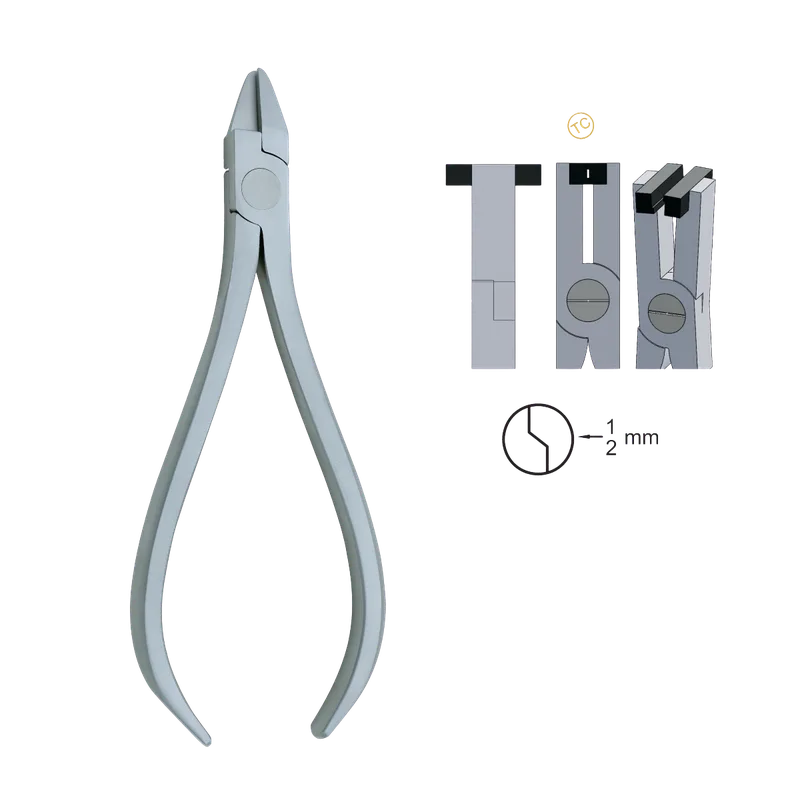
| 0.25 mm (1/4) | Very fine correction of a single tooth | Detailing Step Pliers 1/4 mm (TC) |
| 0.50 mm (1/2) | Most common finishing step | Detailing Step Pliers 1/2 mm (TC) |
| 0.75 mm (3/4) | Larger vertical or in-out discrepancy | Detailing Step Pliers 3/4 mm (TC) |
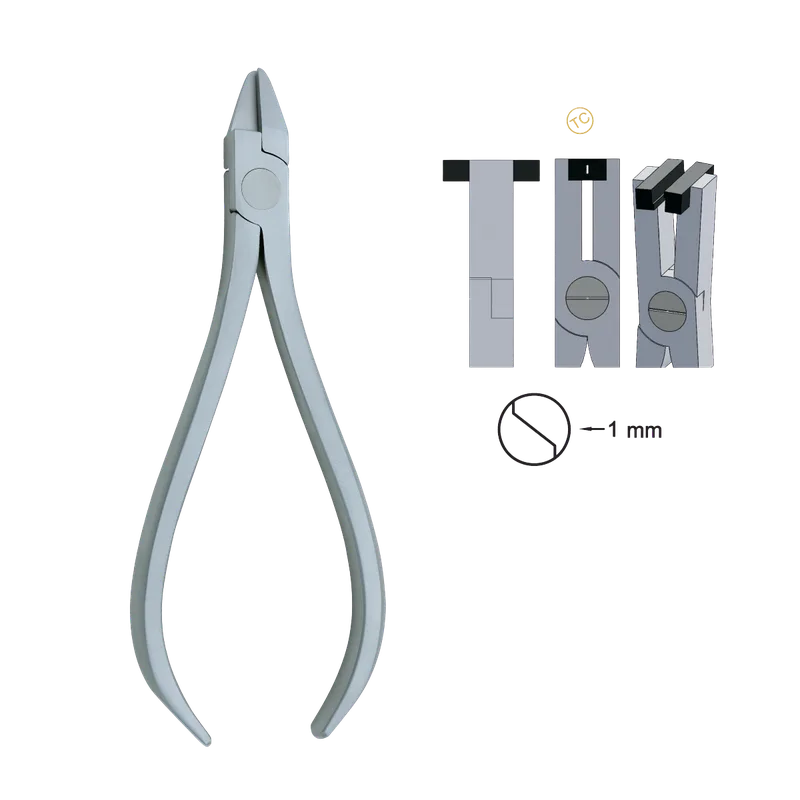
| 1.0 mm | Substantial offsets in a tooth segment | Detailing Step Pliers 1 mm (TC) |
Design features that matter
- Mating step geometry on the jaws, so one squeeze forms the offset rather than two separate bends.
- Tungsten carbide inserts in the working tips, which hold the wire without slipping and resist wear when bending stainless steel rectangular wire.
- Box-joint construction, so the jaws stay aligned and every step is the same height.
- Passivated stainless steel body, ultrasonically cleaned, supplied individually packed and reusable.
Step bend plier vs V-bend stop plier
The two are often confused. A step plier forms a two-bend offset that changes where the wire sits between teeth. A V-bend stop plier folds the wire into a sharp V that acts as a stop against the molar tube, for example to limit sliding in space-closure mechanics. Equate lists a Stop (V-Bend) plier for 0.46 mm (.018 in) wire on the same page for that reason: both are wire-forming tools, but they solve different problems.
If you only buy one, buy the step size you use most. Many clinicians find 0.5 mm the most useful because small corrections dominate finishing.
How to choose one
Check that the tips close without a gap and that the step is formed in a single squeeze. If you bend rectangular stainless steel daily, carbide inserts keep the jaws from marking or slipping on the wire. Decide whether you want a full set of four sizes or one or two sizes only; the sizes are not interchangeable. Before use, verify the step on a scrap piece of wire, because a worn or misaligned joint changes the offset.
Used with a bird beak or Tweed plier for round and loop bends, a step plier completes a small wire-forming kit. See the archwire bending procedure for where each fits.
Pricing context
Equate lists its step plier at EUR 74.90 ex-VAT, about 44% below the EUR 134.80 median premium European RRP for orthodontic wire-forming pliers.
The Equate difference
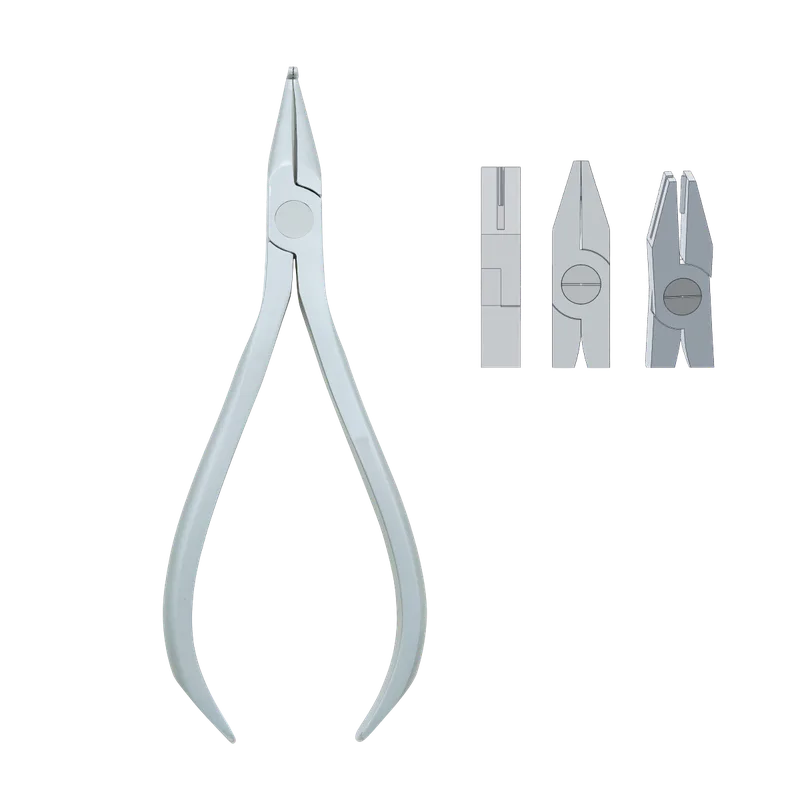
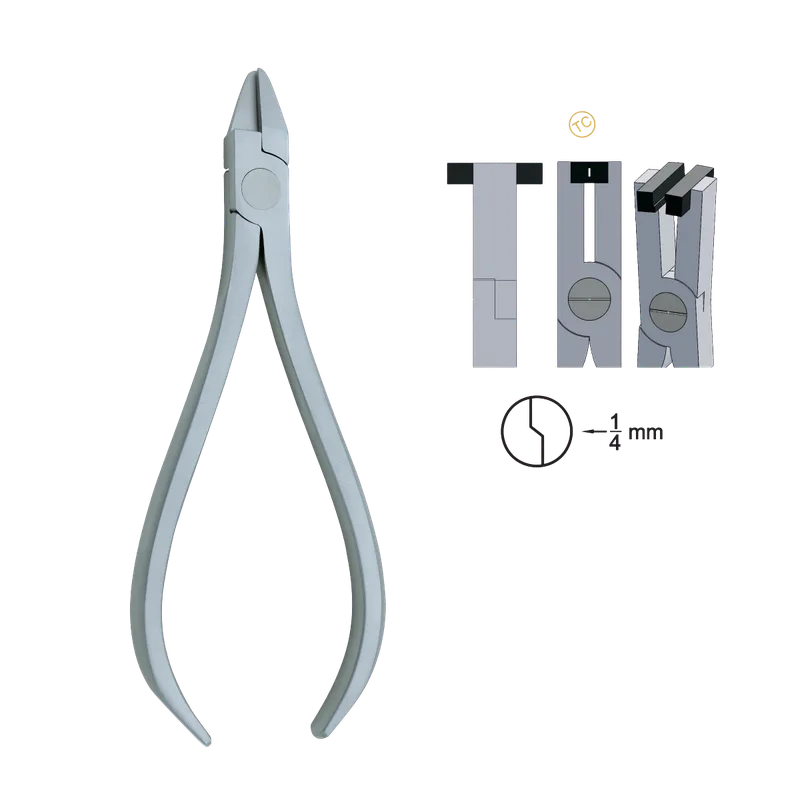
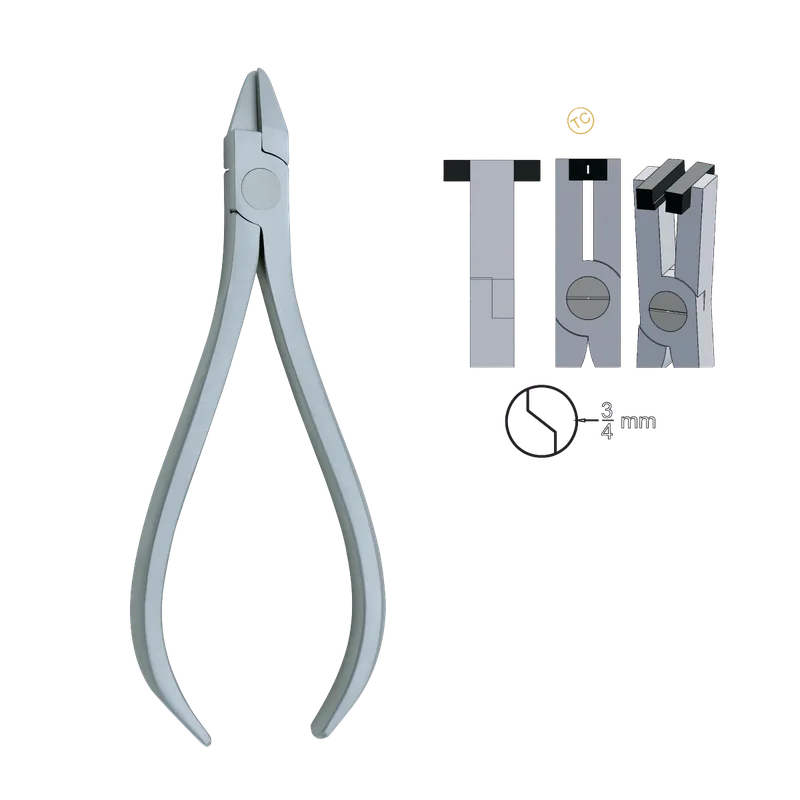
Equate lists four Detailing Step Pliers (TC) in 1/4 mm, 1/2 mm, 3/4 mm and 1 mm step sizes, plus a Stop (V-Bend) plier for .018 in wire, at a list price of EUR 74.90 for the step pliers.
Equate Step Bend Plier options
Frequently asked questions
What is a step bend plier used for?
It places a small precise offset in an archwire, usually between 0.25 mm and 1 mm, to correct minor tooth position discrepancies during finishing and detailing.
What size step plier should I buy first?
A 0.5 mm step is the most commonly stocked size for finishing, because most late-stage corrections are small. Add 0.25 mm or 0.75 mm if you do frequent fine detailing.
Which way do I bend to move a tooth out?
A published clinical tip states that to step a crown out, you bend the archwire in, and to step it in, you bend the wire out. Confirm against your treatment protocol.
Can step pliers bend rectangular wire?
Yes. Step pliers are designed for rectangular finishing wire, and vendors describe sizes up to about .022 x .028 in. Tungsten carbide inserts help hold the wire while bending.
What is the difference between a step plier and a V-bend stop plier?
A step plier creates an offset that moves wire position between teeth. A V-bend stop plier creates a V-shaped stop that prevents the wire sliding through a tube or bracket.
Are step pliers autoclavable?
Equate step pliers are reusable stainless steel with a passivated finish and can be cleaned ultrasonically and autoclaved. Follow the instructions for use supplied with the instrument.
References
- First order artistic wire bends tip, Illinois Association of Orthodontists
- Specialized Pliers for Specialized Wires, Orthodontic Products (2007)
- Vendor step plier specifications, businessmedinstruments.com
- ISO 13485:2016 Medical devices quality management systems
I am a…