Orthodontic Wire Bender
Written & reviewed by the Equate Technical Team · Updated
An orthodontic wire bender is any hand instrument that forms a bend in an archwire, from step and V-bend pliers to loop-forming pliers and distal end benders. In Equate's range the wire bender is a V-tip distal end bender that crimps and folds the wire end against the buccal tube.
What counts as a wire bender
Wire bender is a broad term. Practitioners reach for different instruments depending on the bend: a step plier for an offset, a V-bend stop plier for a stop, a loop-forming plier such as the Tweed for loops, a bird beak plier for small radii, and a distal end bender for the end of the wire. The Orthodontic Products article on specialised pliers describes how different pliers suit different wires and tasks.
Because wire-bending pliers are used with stiff alloys, hardness and joint accuracy matter. Tungsten carbide inserts, covered in the carbide comparison page, help keep jaws from slipping on stainless steel.
Wire benders at a glance
| Tool | Bend it makes | Typical use |
|---|---|---|
| Step bend plier | Small offset (0.25 to 1 mm) | Finishing and detailing |
| V-bend stop plier | Sharp V stop | Stops against a tube |
| Tweed loop forming plier | Loops | Space closure loops |
| Bird beak plier | Small radius bends | General wire forming |
| Distal end bender | Fold at wire end | Securing the archwire behind the tube |
The Equate wire bender
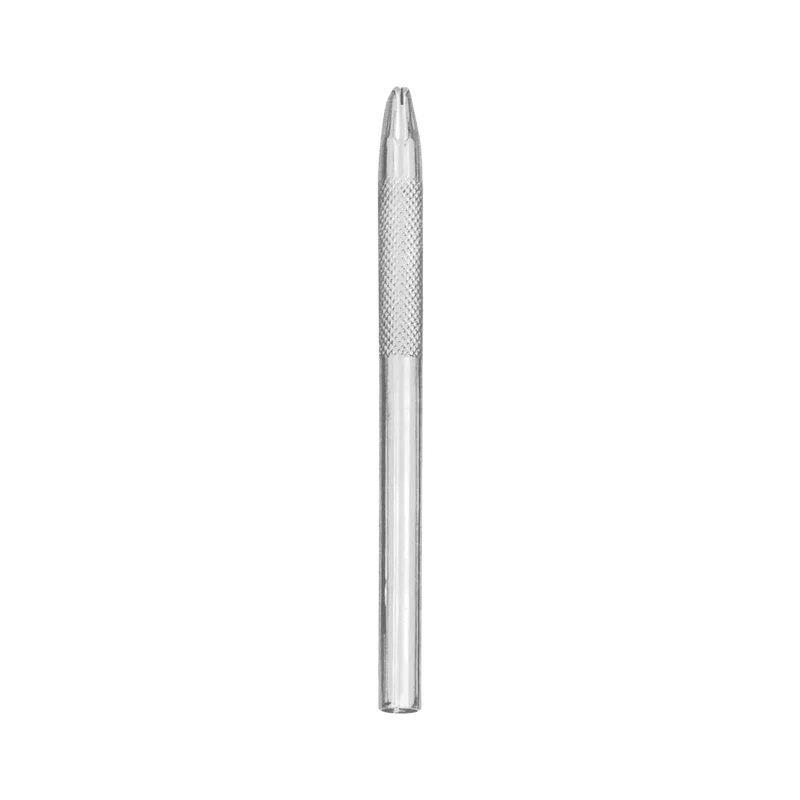
The Equate Distal End Bender is a small chairside instrument that crimps and bends the distal end of an archwire against the molar tube, rather than cutting it free. A V-shaped pincer head captures the wire tip, which preserves the full length of memory-alloy wires and keeps the cut end from irritating the cheek. The short knurled handle fits a gloved grip and takes little room in a cassette.
The textbook rule for the bend is the same as for any cinch back: distal to the most distal bracket or tube, bilaterally, per the Pocket Dentistry archwire-shift chapter.
Choosing a wire bender
- Start from the wire: round or rectangular, stainless or NiTi, and its size.
- Match the bend: offset, stop, loop or end fold.
- Prefer passivated stainless steel for repeated autoclaving.
- Test on scrap wire before using intraorally.
- Check that the joint has no side play.
Care
Clean wire residue and polish debris from the jaws, lubricate joints, and autoclave. A bender whose tips no longer meet or whose jaws show wear will form inconsistent bends and should be replaced or refurbished.
The Equate difference
Equate lists the Distal End Bender (EI-2568) in its wire bender category, with a V-shaped pincer head and a short knurled stainless steel handle, at a list price of EUR 74.90.
Equate Orthodontic Wire Bender options
Frequently asked questions
What is an orthodontic wire bender?
Any hand instrument that forms a bend in an archwire, including step, V-bend, loop and distal end tools.
What does the Equate wire bender do?
It is a V-tip distal end bender that folds the wire end against the buccal tube.
Is a wire bender the same as a wire cutter?
No. A bender shapes wire; a cutter severs it. Distal end benders are used where cutting would waste wire length.
Which bender suits finishing detailing?
A step bend plier, commonly in 0.5 mm, is used for small vertical or in-out corrections.
Are tungsten carbide tips needed?
They are not essential but resist wear on stainless steel wire.
Can I bend NiTi with these tools?
NiTi resists permanent bending; check the tool's stated wire range.
References
- Specialized Pliers for Specialized Wires, Orthodontic Products (2007)
- Archwire Shift chapter on cinch-back bends, Pocket Dentistry
- ISO 13485:2016 Medical devices quality management systems
I am a…