Orthodontic Cheek Retractor
Written & reviewed by the Equate Technical Team · Updated
An orthodontic cheek retractor is a chairside frame that holds the lips and cheeks away from the labial tooth surfaces. It gives access and a clear view for bracket bonding, debonding and intraoral photography, and helps keep saliva and soft tissue off the working field, though it does not give full isolation.
What a cheek retractor is for
Most orthodontic bonding happens on the labial surfaces, where the lips and cheeks constantly try to fold back in. A retractor holds them out so the operator can see every bracket position and so adhesive is not contaminated by moisture or tissue. Manufacturer guidance from Ivoclar notes that blood and saliva harm adhesive bonds and presents relative isolation with a lip and cheek retractor as an alternative where a rubber dam is not possible or too time-consuming.
The same frame is used for intraoral photography, where clinics photograph the dentition before treatment and at review. Supplier guidance stresses symmetrical displacement of lips and cheeks, because uneven retraction can distort the apparent midline and arch relationship and make photographs from different visits harder to compare.
Design of the Equate retractor
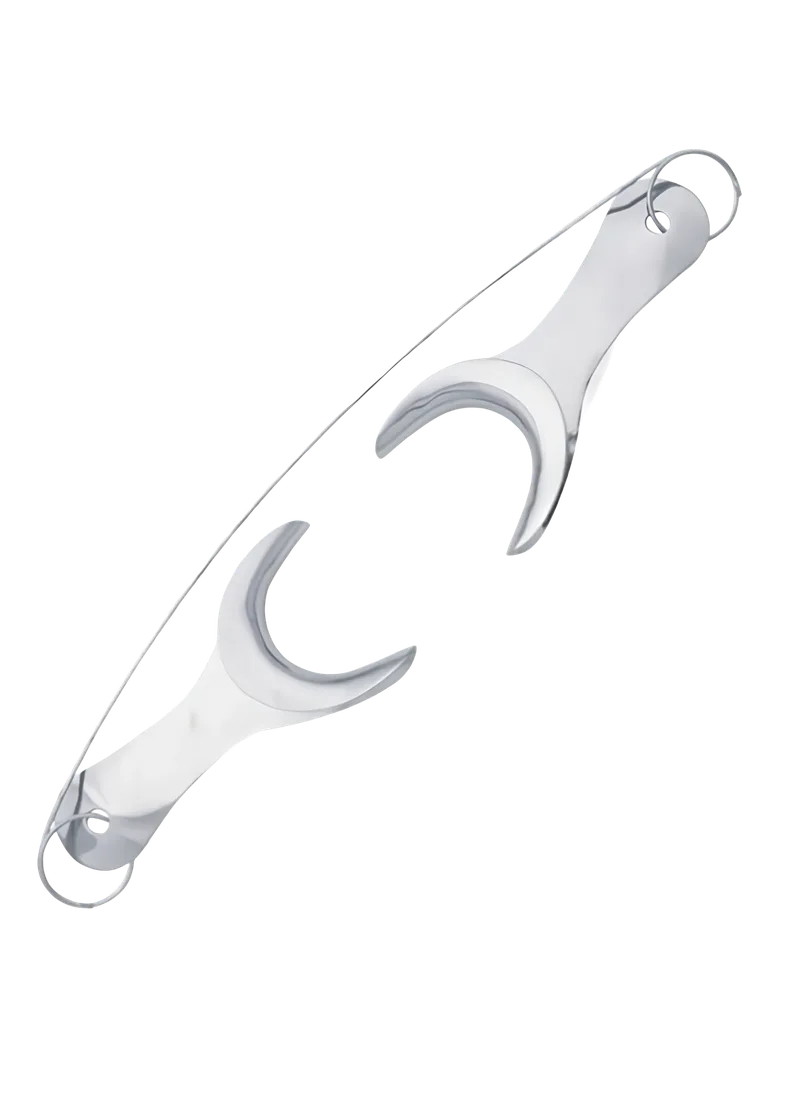
- Paired, polished C-shaped arms that cradle the commissures symmetrically.
- A slim peripheral wire frame that holds the shape and controls tension on soft tissue.
- Formed from a single piece of polished stainless steel with a smooth finish.
- Reusable, passivated, ultrasonically cleaned and autoclavable.
- Supplied non-sterile and individually packed.
Metal and plastic retractors compared
| Property | Metal retractor | Disposable plastic retractor |
|---|---|---|
| Reprocessing | Autoclavable, reusable | Single use or limited heat tolerance |
| Durability | Does not distort with repeated cycles | May haze or warp with heat sterilisation |
| Photography | Visible in frame, usually removed from the view by positioning | Often clear, minimal visual interference |
| Hygiene routine | Needs cleaning and sterilising every patient | Discard after use |
Using a retractor safely
Place the retractor one side at a time, check that no tissue is trapped under the frame and ask the patient to relax the lips. Supplier guidance warns that excessive stretching, incorrect sizing, trapped tissue and prolonged pressure can cause discomfort and mucosal injury, so use it only as long as needed and release between steps where possible.
Retraction improves access but does not provide complete isolation. Where the moisture control demand is stronger, as with some adhesive systems, a dental dam or additional isolation may still be needed. A retractor also cannot compensate for poor suction or saliva control.
What to look for when choosing
Check that both sides are symmetrical, the edges are smooth with no burrs and the frame returns to shape after flexing. Metal retractors with a thin frame suit orthodontic work because they leave the anterior teeth fully visible. A single-piece construction avoids welded joints where debris can lodge during cleaning.
Paediatric and adult frames are not interchangeable: if a practice treats children, consider a smaller size in addition. Clean the instrument immediately after use, sterilise in a pouch, and inspect for deformation before each use.
The Equate difference
Equate lists 1 cheek retractor, the Orthodontic Double-Sided Cheek Retractor (EI-3266), formed from a single piece of polished stainless steel with paired C-shaped arms, supplied non-sterile and autoclavable.
Equate Orthodontic Cheek Retractor options
Frequently asked questions
What is a cheek retractor used for in orthodontics?
It holds the lips and cheeks away from the teeth during bonding, debonding, direct bracket placement and intraoral photography.
Does a cheek retractor isolate the field completely?
No. It provides relative isolation and access; some procedures still need a dental dam or additional moisture control.
Can a metal cheek retractor be autoclaved?
Yes. Stainless steel retractors can be cleaned and autoclaved, whereas some plastic retractors haze or distort with heat.
What is the difference between a cheek retractor and a lip retractor?
The terms overlap. A double-sided frame retracts both lips and cheeks symmetrically; smaller designs retract one side at a time.
Can a retractor be used for intraoral photographs?
Yes. Symmetrical retraction is important for consistent photographs across visits.
How do I avoid discomfort for the patient?
Pick the correct size, avoid over-stretching, check that no tissue is trapped and release the retractor when not needed.
References
- Prep, click, focus: easy access and clear visibility of the treatment site (Ivoclar)
- A lip retractor for intraoral photography (PubMed record)
- ISO 13485:2016 medical devices quality management systems
I am a…