Vernier Caliper (Dental)
Written & reviewed by the Equate Technical Team · Updated
A dental vernier caliper is a sliding measuring instrument whose main scale reads in millimetres and whose auxiliary vernier scale resolves fractions of a millimetre. Dentists use it to measure tooth widths, arch dimensions, wax patterns and study-model landmarks, and surgical versions such as the Castroviejo caliper measure tissue and graft dimensions.
The vernier principle
A vernier caliper adds a second, shorter scale to the sliding jaw. Its divisions are made slightly smaller than main-scale divisions, so only one vernier line lines up with a main-scale line at any position. That line tells you the fraction of the last millimetre, letting a person read finer than the eye can judge between two main-scale marks.
ISO 13385-1:2019, the international standard for callipers with vernier, dial or digital readout, fixes the main-scale interval of a vernier calliper at 1 mm. It also states that the maximum permissible error cannot be smaller than the scale interval of the vernier or the digital step, and its tests are referenced to 20 degrees C. Those rules are why a calliper's resolution and its accuracy are not the same thing.
Dental and surgical forms
| Form | Range | Typical use |
|---|---|---|
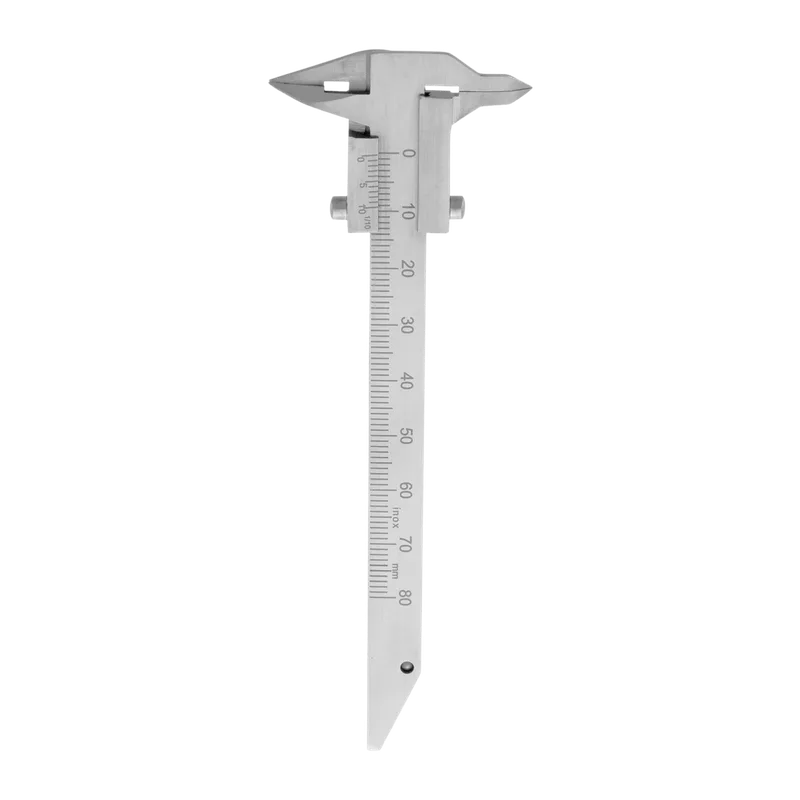
| Vernier Dental Caliper 130 mm | About 0-130 mm | Tooth widths, models, wax patterns |
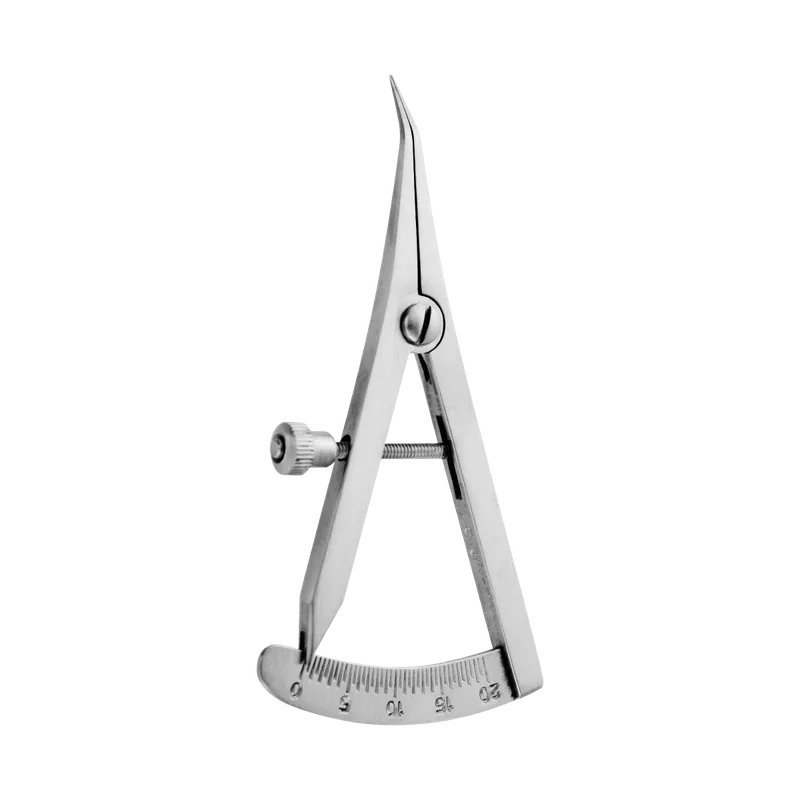
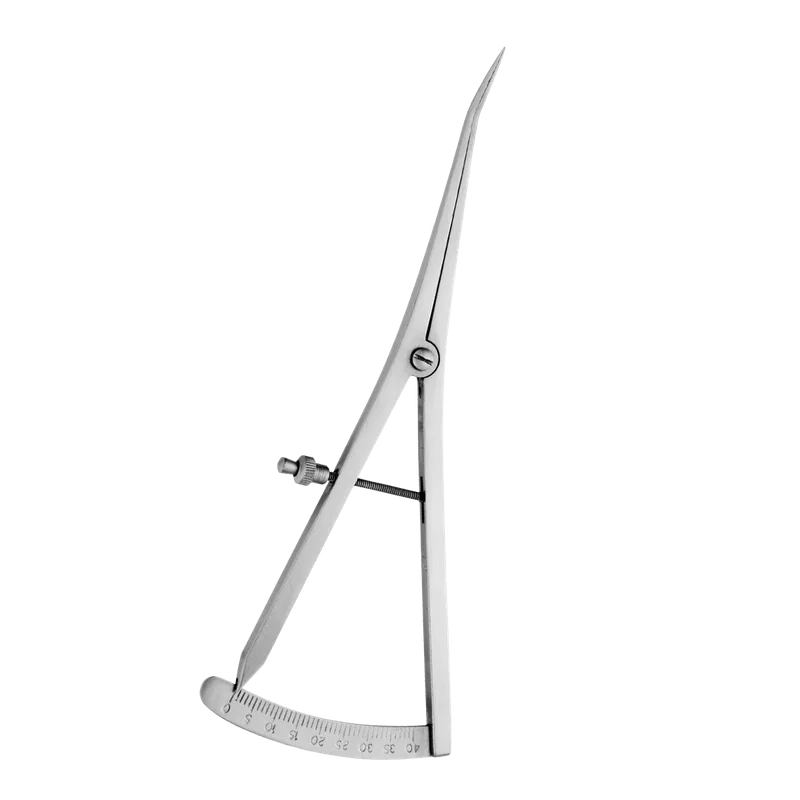
| Castroviejo caliper, curved | 0-20 mm | Tissue and graft dimensions in tight sites |
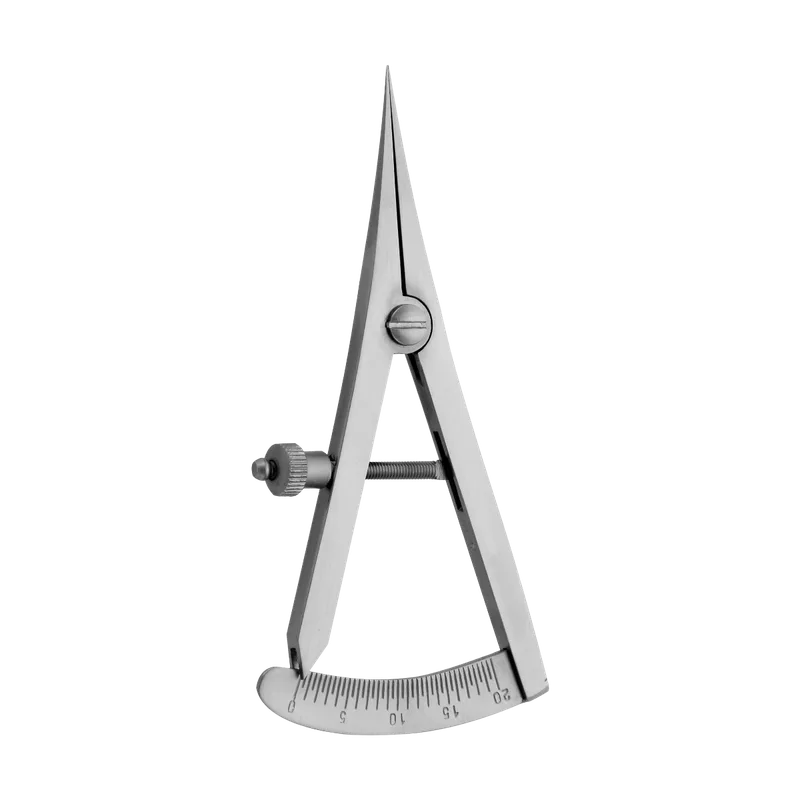
| Castroviejo caliper, straight | 0-20 mm | Small linear measurements, flap and lesion size |
| Castroviejo caliper, angled | 0-40 mm | Wider measurements with improved visibility |
Where the measurement matters
Chairside, a vernier caliper measures the width of a missing tooth gap before choosing a prosthetic tooth, the dimensions of a wax pattern, or the arch width on a study model. In surgery, a Castroviejo caliper, which has fine arms and a scale designed for access, measures soft-tissue and graft dimensions where a rigid ruler cannot reach.
Orthodontists often use Boley-style gauges for model analysis; the Boley gauge page covers the tooth-width literature in more detail. A general vernier caliper overlaps with it, and the choice often comes down to jaw shape and reach rather than scale design.
Accuracy and error sources
- Zero error: jaws closed must read zero; correct or replace if they do not.
- Parallax: read the vernier at eye level, square to the scale.
- Jaw pressure: heavy pressure on a soft wax pattern or tissue deflects the reading, so use light, consistent contact.
- Alignment: tilted jaws overestimate width; keep the beam parallel to the dimension measured.
- Temperature: ISO 13385-1 references 20 degrees C, so large temperature swings introduce small errors in precision work.
- Wear and damage: nicked or bent jaw tips shift the reference, so replace them.
Selecting a vernier caliper for the clinic
Choose range and tip shape for the commonest job. A 130 mm body with straight, parallel jaws serves model work; a 0-20 mm Castroviejo form suits intraoral and surgical measurement. Stainless steel with a clear, etched scale keeps its legibility through repeated cleaning. Equate's calipers are passivated, ultrasonically cleaned, reusable and latex free, supplied non-sterile for autoclaving in the clinic after use.
Verification routine
A practice that records measurements in the chart or on a planning sheet may check a caliper against a known length such as a gauge block at set intervals and record the result. Document who checked it and when; this simple record supports the quality system most clinics already keep. Replace any caliper that fails the zero check or shows play in the slide.
The Equate difference
Equate lists 4 vernier-type calipers in stainless steel: a 130 mm Vernier Dental Caliper plus Castroviejo Surgical Calipers in curved 0-20 mm, straight 0-20 mm and angled 0-40 mm forms.
Equate Vernier Caliper (Dental) options
Frequently asked questions
What is a vernier caliper used for in dentistry?
It measures tooth width, arch dimensions, wax patterns and study-model landmarks to a fraction of a millimetre. Surgical forms measure tissue and graft dimensions.
What is a Castroviejo caliper?
A Castroviejo caliper is a fine-armed surgical caliper with a millimetre scale, used for measuring soft tissue, grafts and lesions in small sites. Equate lists curved 0-20 mm, straight 0-20 mm and angled 0-40 mm versions.
How does a vernier scale work?
The vernier scale's divisions are slightly shorter than the main-scale divisions, so the one vernier line that aligns with a main-scale line gives the fraction of a millimetre between main-scale marks.
Is a vernier caliper more accurate than a ruler?
It resolves finer fractions of a millimetre and holds parallel jaws against the object, so it is usually more precise. Accuracy still depends on zero setting, jaw alignment and consistent pressure.
What does ISO 13385-1 cover?
It specifies design and metrological characteristics of callipers with vernier, dial or digital readout, including the 1 mm main-scale interval and maximum permissible error limits referenced to 20 degrees C.
Can dental calipers be autoclaved?
Stainless steel calipers designed for reuse, such as Equate's, can be cleaned and autoclaved. Dry them completely and avoid dropping them, which can bend the jaws.
References
- ISO 13385-1:2019 Geometrical product specifications, dimensional measuring equipment, design and metrological characteristics of callipers
- ISO 14253-1 decision rules for conformity with specifications
- Comparison of three different instruments for orthodontic study model analysis, South African Dental Journal 2020
I am a…