Ligature Tying Plier
Written & reviewed by the Equate Technical Team · Updated
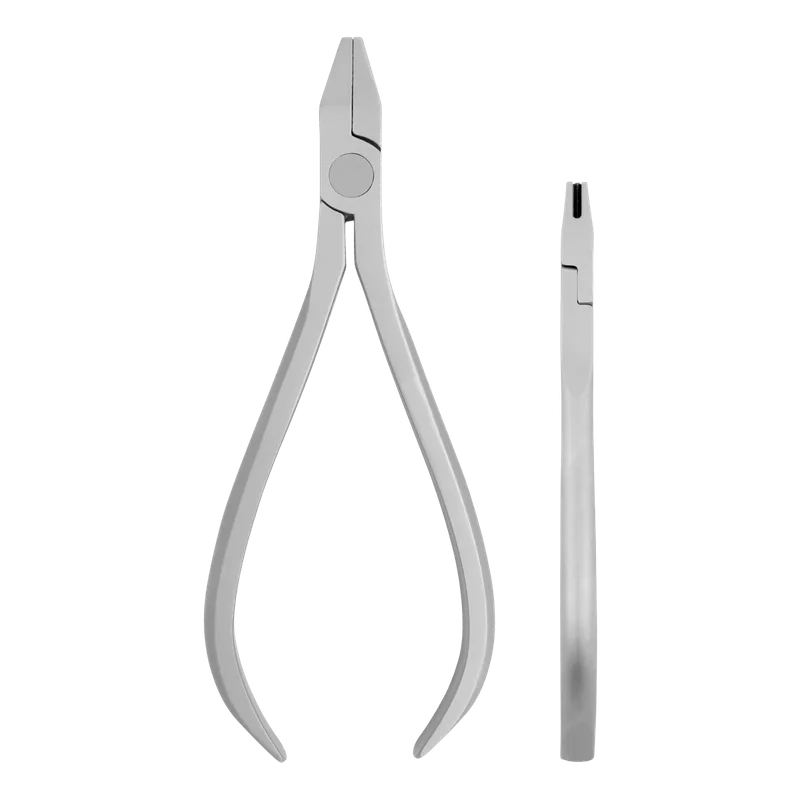
A ligature tying plier is a long, slim plier that grips both legs of a stainless steel ligature wire and twists them into a tight pigtail around a bracket, securing the archwire in the slot. Its low-angle curved beaks let the clinician pick up, twist and release the ligature with one instrument.
Steel ligation and the tying plier
Stainless steel ligatures are thin wires looped around the bracket wings and over the archwire, then twisted. The plier grips the two free legs and turns them, forming a pigtail that is then cut short and tucked. A review in Orthodontic Update covers steel ligation as one way of holding an archwire, and reviews of ligation note that tightness depends on operator technique.
In vitro friction studies generally report lower sliding resistance for steel ligatures than for conventional elastomeric ligatures on conventional brackets, though results vary with bracket, wire and tie tightness, and in vitro results do not fully translate to clinical tooth movement.
Steps in a typical tie
- Pass the ligature around the bracket under the tie wings and over the archwire.
- Grip the two legs close to the bracket with the tying plier.
- Twist to a tight but not binding pigtail.
- Cut the pigtail with a ligature cutter.
- Tuck the end with a ligature tucker and check that the archwire is seated.
Tying versus forming pliers
| Feature | Ligature tying plier | Ligature forming plier |
|---|---|---|
| Purpose | Twists ligature legs around brackets | Shapes ligature wire into consistent ties |
| Equate model | Ligature Tying Pliers 17 cm | Ligature Forming Pliers 0.50 mm (.020 in) |
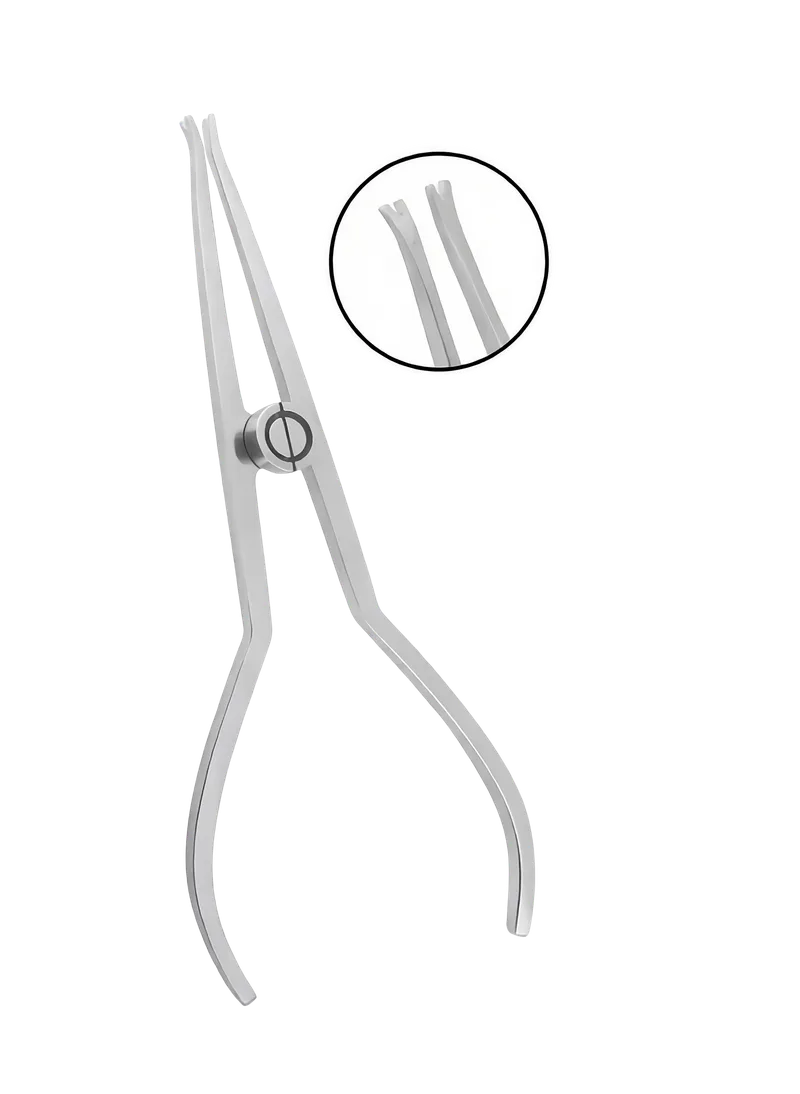
| Beak | Paired curved beaks, low angle | Stepped tip forming a V-seat |
| Pivot / handles | Screw pivot, long slim body | Lightweight plain round handles |
| Used with | Fine steel ligature wire | Ligature wire up to .020 in |
Choosing a ligature tying plier
Look for beaks that meet fully along their length so fine wire is not squeezed out, with a pivot that moves smoothly without side play. A longer slim body, such as 17 cm, reaches posterior brackets but needs a steady hand. Check that the beaks are slim enough to fit between adjacent brackets.
Elastomeric modules reduce chairside time, so many practices keep a tying plier for cases that call for steel ligation.
Care
Equate ligature pliers are passivated stainless steel, ultrasonically cleaned, latex free, reusable and supplied non-sterile; clean and sterilise before first use. Brush the beaks to remove fine wire fragments, lubricate the pivot, and replace the plier if the beaks no longer meet.
The Equate difference
Equate lists a 17 cm Ligature Tying Plier (EI-3285) with a screw pivot, and a Ligature Forming Plier for 0.50 mm (.020 in) wire, both in passivated stainless steel.
Equate Ligature Tying Plier options
Frequently asked questions
What is a ligature tying plier used for?
It grips and twists stainless steel ligature wire around orthodontic brackets so the archwire is secured in the slot.
What is the difference between a ligature tying plier and a ligature director?
The tying plier grips and twists steel ligature wire. A director guides a ligature into place and does not twist it.
Do I need a tying plier for elastomeric ligatures?
No. Elastomeric ties are placed with a director, applicator or placing forceps, not twisted.
What size ligature wire does the Equate forming plier take?
The Ligature Forming Plier is listed for 0.50 mm (.020 in) wire.
What do I use after tying?
A ligature cutter to trim the pigtail and a ligature tucker to tuck the end under the archwire.
References
- Stainless steel ligatures in orthodontic treatment, Orthodontic Update (2021)
- Evaluation of friction using various bracket and archwire combinations, in vitro study (PMC)
- Friction produced by types of elastomeric ligatures in preadjusted appliances (PubMed)
- ISO 13485:2016 medical devices quality management systems
I am a…